
A Rider's Guide to Yellowstone National Park

The Yellowstone National Park landscape is a dramatic theater of geothermal wonders, deep canyons, and expansive alpine meadows just waiting to be explored by motorcycle. We know it's not located within Utah's borders, but at only six hours from Salt Lake City, it is one of the most common destination for our renters.
The ride to this iconic destination takes you past majestic mountain ranges, deep blue lakes, and pristine valleys. With entrances located at the West, South, and East of the park boundaries, you have direct access to an excellent variety of routes, accommodations, camping, and other recreational opportunities.
With nearly 5 million of visitors touring the park every year, advance preparation is key to making the most of your limited time. This post will walk you through the necessities of planning your moto-trip, specific motorcycle route recommendations, seasonal closures, and practical advice so your big trip is all fun and no hassle.
Reservations & Logistics
The most important things to know is that Yellowstone has no advance reservation system in place, and it closes seasonally due to winter weather. Its high volume of summer traffic creates significant congestion. Wildlife delays caused by elk, bison, and bear near roadways can halt traffic for miles.
Entry fees: $30, but one fee admits per two motorcycles arriving at the same time. The pass is valid for multiple entries within a seven consecutive day period. If you plan to visit other neighboring National Parks or Monuments on the same trip, an America the Beautiful Annual Pass is a smarter investment. It also allows for two motorcycles to enter per one pass.
Seasonal access: Most park roads are open to cars & motorcycles beginning in late April or early May. Roads through the park close in early November to prepare for winter snowmobile traffic. The section between the North Entrance (Gardiner) and Northeast Entrance (Cooke City) is the only road kept open to automobiles year-round. Outside of their winter season, the park gates are open 24/7.
Gasoline & amenities: Unlike more compact parks, Yellowstone features fully developed villages inside the interior. Service stations with gasoline are available at Mammoth Hot Springs, Tower Junction, Canyon Village, Fishing Bridge, Grant Village, and Old Faithful. You will also find general stores and lodging inside the park boundaries.
How long should you budget in the park? To ride the entire main loop and see the primary sights without rushing, we recommend budgeting two full days. Because of traffic, wildlife stoppages, and all the pictures you'll want to take, riding just the 142-mile Grand Loop Road can take up to 10-12 hours to complete. We suggest breaking the figure-8 loop into two day-long rides with time set aside to explore off the bike.
Essential Gear to Pack
The weather in Wyoming and Montana's high-elevation country is notoriously fickle. Mornings and evenings can be cold, with toasty temperatures at high noon. Severe afternoon thunderstorms and hail are not uncommon during the summer. We suggest reviewing the park website each day for the most up-to-date weather and road condition notices
Spring (April- May): Mountain passes still hold snow walls, and morning ice is a real hazard. Daytime temperatures range from 30°F to 60°F (0°C to 16°C) with overnight lows in the teens to single digits (-5°C to -20°C). Snow is common in the spring and fall with regular accumulations of 12 inches (30.5 cm) in a 24-hour period. We suggest packing heated gear or thermal layers, and ensure you bring a waterproof layer. We would not recommend planning a motorcycle trip to Yellowstone before April due to remnant snow & ice.
Summer (June - August): Daytime temperatures are pleasant, usually ranging from 70°F to 80°F (21°C to 26°C), but early mornings remain crisp. Vented riding jackets with removable windproof liners offer the best versatility for shifting elevations.
Autumn (September - October): This is a spectacular time to ride due to reduced crowds and active wildlife, but temperatures drop fast. Pack mid-layers and heated gear for an enjoyable ride. Temperatures are similar to springtime. We would not suggest planning a visit by motorcycle after mid-October due to the chance of early winter snowstorms.
Winter (December - February): We don't recommend motorcycling to Moab during the winter. It can be bitterly cold with unexpected weather, plus the route to & from Salt Lake City takes you over high mountain passes that often see snow. But do drive down in a car or truck and discover the quiet, peaceful side of Moab.
Essentials: Always carry plenty of water with you on the motorcycle, as you'll be in a dry, high-elevation environment. Bring extra water if you plan on a campfire. A rain layer is a good idea, as flash thunderstorms can happen. If you are exploring the backcountry, we strongly suggest bringing an emergency communicator (Garmin inReach, etc) and a personal radio that can pick up weather report frequencies.
Suggested Routes
Most direct routes to Yellowstone:
West entrance: From Salt Lake City, follow I-15 North to Idaho Falls, Idaho. Take Route 20 until you reach West Yellowstone. Google Maps link
South entrance: From Salt Lake City, follow I-15 North to McCammon, Idaho. You'll go east to Soda Springs, head north then east into Thayne, then continue north on WY-89 then WY-191 through Jackson. Google Maps link
North and East entrances: Use these as exits to access Cody or Montana (including the Beartooth Hwy).
Most enjoyable route to Yellowstone:
We recommend riding to the South Entrance, as the route linked below will allow you to eliminate a lot of time on I-15.
From Salt Lake City, follow I-15 North to Brigham City, Utah. Head northeast on US-89 (State Street) into Logan. Passing Bear Lake, continue on US-89 over the Wyoming border and through Star Valley before turning east in Alpine, WY. Follow US-89/191 through Jackson to Yellowstone. Grand Teton National Park will be on your left! Google Maps link

Inside Yellowstone:
The primary park infrastructure consists of a 142-mile road shaped like a giant figure-eight called The Grand Loop Road. It is entirely paved, well-maintained, and split into two primary circuits:
The Upper Loop: Highlights include the terraced hot springs at Mammoth, the roaring Tower Fall, and the sweeping views of the Dunraven Pass. It is also the highest road section in the park at 8,859 feet (2,700 m). Budget 4-6 hours with stops.
The Lower Loop: This section holds more of the park's geothermal features, including Old Faithful, Grand Prismatic Spring, and the breathtaking overlooks at the Grand Canyon of the Yellowstone. Budget 4-6 hours with stops.

Day-trips:
Grand Teton National Park: Since you're in the neighborhood, it would be a travesty to skip out on this park. Teton Park Road is incredibly scenic, bringing you along the shores of Jackson and Jenny Lakes. It can be ridden in either direction, but the Jenny Lake loop is one-way (north to south).
Driggs & Victor, Idaho: Located on the backside of the Tetons, these small towns are some of our favorite in Idaho. Originally catering to backpackers, mountain bikers, and fly fishers, this region has fewer crowds and a more laid back vibe compared to Jackson. The Teton Pass is an exceptionally fun curvy road between Victor and Jackson. If you're a dirt rider, try the Ashton-Flagg Ranch Road which will guide you over the north end of the Tetons to the South Entrance of Yellowstone
The Beartooth Highway: Starting from the Northeast Entrance, this legendary route climbs to nearly 11,000 feet (3,400 m) over a series of intense switchbacks and alpine plateaus. It is widely considered one of the top motorcycle roads in North America, but is only open from Memorial Day to October due to high elevation snow. Having done it ourselves, the road and views do not disappoint!
Chief Joseph Scenic Byway: Connects the Beartooth Highway down to Cody, Wyoming and Yellowstone's East Gate. Offers sweeping high-desert canyon views and beautiful asphalt sweeping curves. We found less traffic on this route compared to Beartooth. Cody is a fun "Wild West" town with plenty to see and do!
Amenities at a Glance
Accommodations
In the park:
Forested area near Grand Canyon of the Yellowstone. Over 500 rooms/suites and basic cabins. No AC, TV, or in-room cooking. WiFi available. $$$ | |
Southern region on Yellowstone Lake near Grand Teton. Six two-story buildings with basic rooms. Features mini-fridges, coffee makers, on-site restaurant, and gift shop. No WiFi, AC, TV, or in-room cooking. $$ | |
Northern shore of Yellowstone Lake. Historic landmark offering upscale hotel rooms/suites and basic adjacent cabins. Features lake views, restaurant, deli, and pet-friendly cabins. No AC, TV, WiFi. $$$ | |
Overlooks Yellowstone Lake. Main lodge with 186 basic cabins behind it. Features mini-fridges, private bathrooms. No WiFi, AC, TV, or in-room cooking. $ | |
A variety of rooms and cabin style from standard rooms to cabins with private hot tubs. No WiFi, AC, TV, or in-room cooking. $$ | |
Iconic historic landmark adjacent to Old Faithful. Wide range of rustic rooms (with or without private baths) and suites. Features a full-service restaurant, deli, bar, and gift shop. No WiFi, AC, TV, or in-room cooking. $$$ | |
Historic facility near Old Faithful. One-story main lodge with options of basic private cabins or cabins using communal facilities. No AC, TV, or in-room cooking. Public area WiFi. $ | |
The park's newest lodge offers a variety of room types, from deluxe rooms to rustic cabins. No AC, TV, or in-room cooking. WiFi available. $$ | |
Remote northeast region near Lamar Valley. Old West style rustic cabins with options private or communal facility options. No WiFi, AC, TV, or in-room cooking. $ |
Outside the park:
Gateway towns offer robust infrastructure to support the millions of annual tourists in the area.
West Yellowstone, MT: The busiest gateway, packed with standard motels, cabins, and diverse dining options.
Gardiner, MT: Located at the North Entrance, offering a more rustic river-town vibe with quick access to Mammoth Hot Springs.
Cody, WY: Located 50 miles east, but serves as an excellent base camp for riding the Chief Joseph and Beartooth loops.
Jackson, WY: The closest gateway town to the South Entrance, Jackson is as glamorous as you imagine while still offering lodging options for all price points.
Camping
Established, paid:
Yellowstone has 11 campgrounds with over 2,000 established campsites, but all campsites must be reserved in advance. Reservations open on a rolling basis, so you can book your site exactly six months before the date of your stay, as long as reservations are available for that time. Most campsites are reserved far in advance, so it is recommended that you make reservations as early as you can. There is no first-come first-serve availability from spring-autumn!
Campgrounds can be booked either through Yellowstone National Park Lodges or the Recreation.gov site or app.
Yellowstone camping information
Primitive, free:
There is no dispersed camping in Yellowstone, except for hike-in backcountry camping which requires a separate permit. We suggest camping outside of Yellowstone Park boundaries. Consider areas in the
Custer Gallatin and Bridger-Teton National Forests.
Fuel
Yellowstone has seven service stations located throughout the park.
Grocery stores & restaurants
Yellowstone has twelve general stores throughout the park where you can find food, amenities, and other goods.
There is also a variety of quick-serve restaurants, bakeries, and fine dining options within the park boundaries.
Off-the-bike activities
If you love outdoor recreation, you will love Yellowstone! Hiking, biking, horseback riding, backcountry exploration, boating, and fishing. With 2.2 million acres of land, there is so much you can do here between rides.

Frequently Asked Questions
How far is Yellowstone from Salt Lake Airport?
It is approximately a 5-6 hour ride to the the West or South entry gates
Can I do Yellowstone in one day?
We do not recommend it.
How long should I spend at Yellowstone?
We suggest a minimum of two days - do the Upper Loop of The Grand Loop Road on one day, and the Lower Loop the second day.
How much does it cost?
$30 per motorcycle entry fee admits two motorcycles with pillions entering at the same time. Pass is good for 7-days
Another option is the America the Beautiful Annual Pass, which will grant you and one other motorcycle entry to Yellowstone, Grand Teton, and all other US National Parks.
How do I handle wildlife on a motorcycle?
The animals in Yellowstone are wild and dangerous, no matter how docile they may appear to be. This is not a petting zoo! Always stay at least 100 yards (91 m) away from bears, wolves, and cougars, and at least 25 yards (23 m) away from all other animals, including bison and elk. If an animal moves closer to you, back away to maintain a safe distance. It's illegal to willfully remain near or approach wildlife, including birds, within any distance that disturbs or displaces the animal. Use your camera zoom instead!
What about the bears?
You might see a grizzly! If parking your motorcycle for off-bike activities, we'd suggest removing all foods from your packs and panniers. If camping, use the provided food storage lockers at your campground or store food items in a hard-sided bear canister or hang them from a tree. Ask us for more information if you're concerned!
As America’s very first national park, Yellowstone remains a massive sanctuary full of unparalleled natural wonders. From the roaring geothermal power of its geyser basins to the plunging depths of its colorful canyons and the wild expanses of its valleys, the sheer scale of this historic landscape offers an unforgettable encounter with the raw forces of nature. Exploring this preserved wilderness requires flexible planning and a deep respect for the unpredictable alpine elements and abundant wildlife. A motorcycle is one of the best ways to be enveloped by all the sights, smells, and sounds this park has to offer.
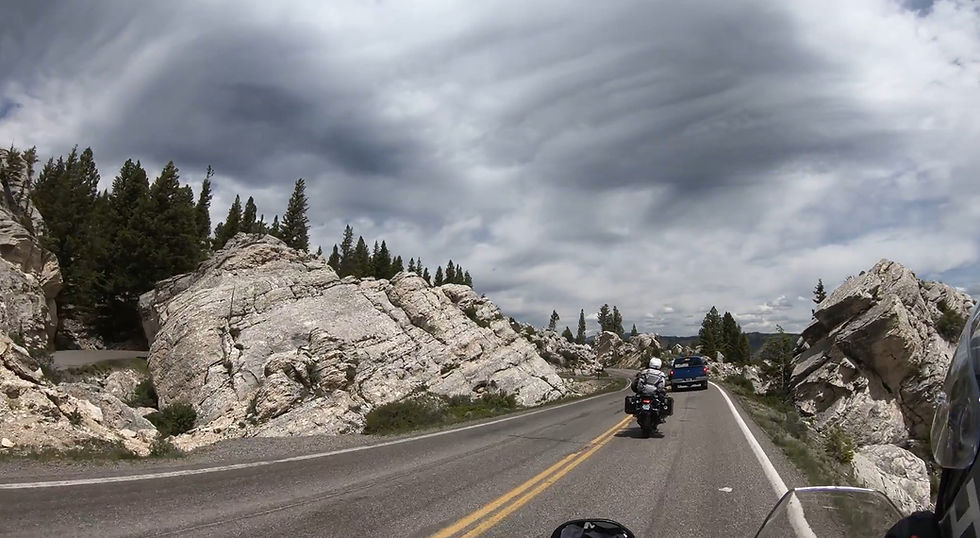
Don't be surprised to see snow in early spring or late autumn You can't beat the views You'll find quirky sights outside the Park gates! Grand Prismatic Spring. Source: Yellowstone NPS
Park Information & Resources
Sites
Maps

Header image credit: Stock image
Other photos taken by Utah Touring
Park map image from Yellowstone.net
Park map PDF from Yellowstone National Park website

Comments